About this digital edition
This site is a preserved and modernized edition of the original Hydebooks project, rebuilt in 2026 by Steps Ventures after the New Jersey Institute of Technology retired its server. The scholarship, transcriptions, and images are the work of Carol Siri Johnson, Andrew Otis, and the NJIT students credited below. Her account of the project follows.
Two things have changed since 2018. First, the archive is now complete: pages that were left blank or unfinished on the original site have been transcribed, so all roughly 22,373 pages carry text. Second, every page is now labeled by how it was read. Pages marked Transcribed by Andrew Otis are his human transcriptions. Pages marked AI-assisted were transcribed with a machine model and should be treated as a first reading. On the human pages, a Compare AI reading option in the reader shows an independent machine transcription of the same page for error-spotting. None of the AI readings have been vetted by an editor, and the human transcriptions remain the reference text.
About the Hydebooks Project
In 2014, Andrew Otis emailed me and said he'd found old shorthand in some judge's notebooks in Kolkata; could I decipher it? I didn't know. I said I'd try. It took seven months but I did it. The first words I deciphered were "Sir Robert Chambers"; the majority of Hyde's hidden comments were about his fellow judges.
In researching the background of the hidden shorthand comments, it became clear that the notebooks, although very difficult to access in Kolkata, were a goldmine of primary historical evidence. During the 1700s, the actions of Parliament and the East India Company were extremely well documented, but little or nothing was known about the life of the colonized. The notebooks contain some of that information and we felt it should be available to scholars. Then, in the preface to Michael J. Franklin's Orientalist Jones, we read that one set of microfilm of the notebooks belonged to Thomas M. Curley. We wrote to him and asked if we could borrow it.
In September 2015, Andrew and I drove to Bridgewater, had lunch with Curley, borrowed the microfilm and undertook this project. As a tenured professor, I became custodian of the eighteen reels of microfilm and, at Rutgers Newark (we don't own a microfilm machine that makes images), I gradually took approximately 22,500 pictures of notebook pages. Andrew, now at the University of Maryland College Park, gradually transcribed the handwritten text.
At the beginning I thought the notebooks could be printed as books. However, this project is so large any books made from it would cost thousands of dollars. Most libraries could not afford them and that would defeat the purpose of the project, which was to make the notebooks accessible to historians and others. Consequently, I decided to post them online.
That decision forced me to relearn html and css and learn javascript, php, sql, Dreamweaver and much more. Fortunately, at NJIT when I couldn't learn something myself, students taught me. It's been an ongoing collaboration, working with different students every semester, as we figure out what has to be done, try to do it and, when it doesn't work, try again. This base website is up now. The chronological browse function, to display each page next to its transcription, is almost working (the month navigation is still off). As time goes on, the students and I will continue to work on it, eventually providing database search capability. When it is all up and working well, hopefully it will provide new historical insights and give a voice to those who have yet to be heard.
Carol Siri Johnson
NJIT Students Who Have Worked on Hydebooks
Spring 2018
| Name | Role |
| Mahmood Khan | Project Manager |
| Wei Wang | Relational Database Designer |
| Rempee Kalia | Web Designer |
| Maxim Tillmann | Historical Data and Cases Design |
| Ajay Ramnikal | Navigation and Data Grooming |
Summer 2018
| Name | Role |
| Andrew Hibberson | Project Manager |
| Mikhail Obvimtsev | Browse Function |
| Richard Chipman | Web Designer, Data Grooming |
| Julio Arroyo | Navigation and Data Grooming |
Fall 2019
| Name | Role |
| Angelica Braxton | Project Manager |
| Daniel Tambor | Lead Developer |
| Vivian Sanchez | Web Designer, Usability |
| Robert Gardineer | Developer |
| John Parra | Developer |
Spring 2019
| Name | Role |
| Srikar Kodati | Project Manager |
| Sarah Graner | Programming Tutor |
| Alex Brebric | Web Designer |
| Kevin Durrenberger | Master Plan |
| Walther Mejia-Contreras | Navigation and Data Grooming |
| Andrew Mastrelli | Text Formatting |
Summer 2019
| Name | Role |
| Darshan Patel | Project Manager |
| Haseeb Hussain | Database Design and Browse Function |
| Marvin Jiho Jung | Browse Function Navigation |
Special Thanks To . . .
| Name | Contribution |
| Osama Eljibiri | Director of the NJIT YWCC Computer Science Capstone program, for enabling projects such as ours. |
| Andrew Otis | for finding the notebooks, researching the history and encouraging me to publish them. |
| Sarah Graner | for being an excellent tutor and web designer. | Tom Curley | for lending us the microfilm and wholeheartedly supporting the project. | Do Hyun "David" Kim | for implementing PHP automation and help optimizing the web site. |
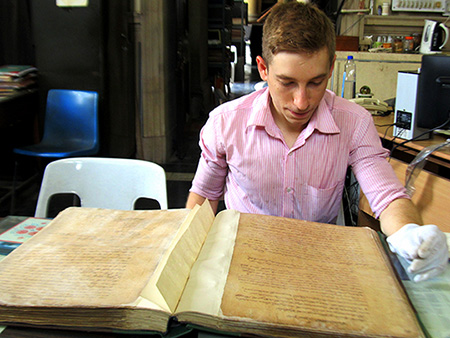
About the Notebooks
Officially called "The Judicial Notebooks of John Hyde and Sir Robert Chambers, 1774-1798," the notebooks were written in Calcutta (Kolkata) by the judges at court. As can be seen at the picture to the left, the books are large folio volumes. They reside at Victoria Memorial Hall. Two sets of microfilm were made in 1977, one of which is at Victoria Memorial. Since access is limited, the images on this website offer a relatively complete and faithful reproduction for the use of scholars and all who are interested.
For a history of the writing in the notebooks and their travels, see Curley's summary, the Navigating the Notebooks page and other secondary sources on this site.
Approximately two-thirds of the pages have been transcribed and the text appears next to the notebook page image. The remainder will be done gradually. Anyone interested in participating should contact cjohnson@njit.edu.